
41% of companies plan to reduce their workforce due to automation
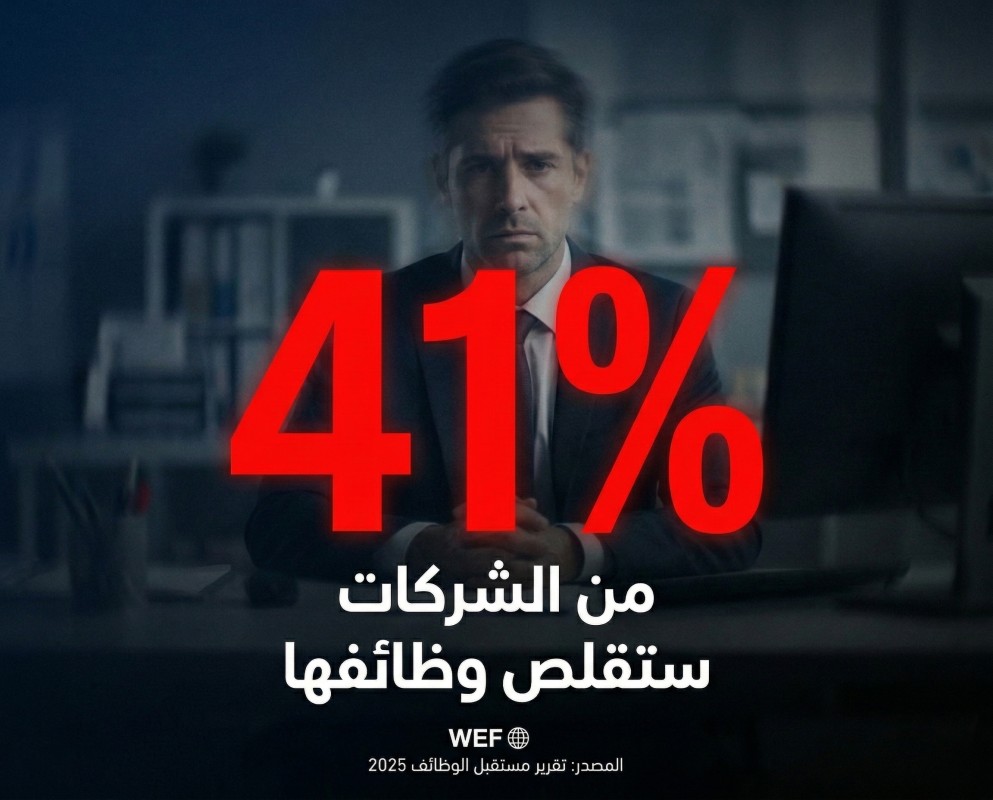
41% of Companies Reduce Jobs Due to Automation: Implications for Your Career
Data Source: World Economic Forum, Future of Jobs Report 2025 | Last Updated: January 2025
Exclusive Report
January 2025 | 9 Minutes Read | 1000+ Companies in 55 Economies
Executive Summary
The WEF 2025 report surveys over 1,000 companies representing 14 million workers across 55 countries. Employers planning to reduce their human workforce in areas where automation is capable account for 41%. Projections indicate 92 million jobs will disappear and 170 million new roles will emerge, resulting in a net addition of 78 million jobs by 2030. Readiness for this labor market shift is the critical factor.
Key Statistics:
- 41% of companies plan to reduce their workforce.
- 92M jobs will disappear by 2030.
- 170M new jobs will be created.
- 300M jobs are threatened globally (Goldman Sachs).
- 39% of current skills will become obsolete before 2030.
Data Sources and Collection Methodology
The WEF "Future of Jobs 2025" report, issued in January 2025, concluded that 41% of employers plan to reduce their headcount in tasks that automation can perform. These represent confirmed plans from corporate leaders actively managing large budgets and making current hiring decisions.
By 2030, humans will exclusively perform 33% of tasks, compared to 47% today. Automation will handle 34% of tasks, and human-machine collaboration will account for the remaining 33%.
Corroborating Financial Institution Data:
- Goldman Sachs (2023): 300 million full-time jobs globally face exposure to automation by generative AI. Two-thirds of current jobs in the US and Europe face some degree of this transition.
- McKinsey Global Institute: Generative AI will automate 30% of working hours in the US economy alone by 2030.
Sectors Most Exposed to Automation
Administrative and clerical jobs face the highest risk at 46%, followed by the legal sector at 44%. Complex manual and maintenance tasks present the lowest risk, ranging from 1% to 6%.
Sector Percentage of Automatable Tasks Risk Level
Administrative and Clerical 46% Very High
Legal Sector 44% Very High
Engineering and Architecture 37% High
Science and Research 36% High
Financial Operations 35% Medium
Education and Training 15% Relatively Low
Healthcare and Nursing 10% Low
Construction and Excavation 6% Low
Repair and Installation 4% Very Low
Cleaning and Manual Maintenance 1% Lowest Risk
Jobs Disappearing First
- Repetitive clerical and secretarial tasks
- Basic accounting entries and invoice processing
- Payroll management and routine legal documentation
- Text-based inquiry customer service
- Data entry and spreadsheet auditing
Jobs Growing During the Shift
Roles involving human communication in healthcare and public administration will increase. Automation manages routine tasks, allowing human workers to focus on complex decisions and interpersonal relationships.
Drivers of Current Acceleration
Three concurrent factors drive this shift: the generative AI revolution since 2022, post-pandemic cost pressures, and the operational maturity of automation tools.
- Generative AI Investment: Since the launch of ChatGPT in November 2022, investment in generative AI has multiplied eightfold.
- Economic Pressure: High living costs compel half of all employers to restructure their business models. Converting human tasks to algorithmic processes provides massive fixed-cost savings in an inflationary environment. According to the WEF survey, 86% of large companies will fundamentally shift toward automation before 2030.
- Technology Maturity: Process robotics and AI agents have achieved accuracy levels that permit practical deployment in business environments without requiring massive infrastructure.
Most Affected Demographics
The Gender Gap
79% of working women hold jobs highly exposed to automation, compared to 66% of men. This disparity widens existing labor market gaps. Youth, senior citizens, and workers in developing nations are also disproportionately affected.
The Obsolete Skills Crisis
120 million workers face medium-term risk due to professional obsolescence. Out of every 100 individuals in the global workforce, 59 require reskilling; projections show 11 will fail to receive it. 39% of core skills required in the labor market will change by 2030. This percentage decreased from 44% in 2023, indicating improved corporate forecasting and preparation.
Youth and Recent Graduates
Entry-level positions in law, finance, and administration—traditional entry points for recent graduates—top the threatened list. The new generation faces a restricted labor market at these specific access points.
Job Creation vs. Destruction
Projections show 92 million jobs eliminated alongside 170 million new roles created by 2030, resulting in a net gain of 78 million jobs globally.
Fastest Growing Roles (Until 2030):
- AI and Machine Learning Specialists
- Big Data Analysts
- Software and AI Application Developers
- Renewable Energy and Sustainability Engineers
- Specialized Healthcare and Nursing Staff
- Technical and Vocational Education Teachers
- Cybersecurity Specialists
The Augmentation Model
High-performing companies deploy automation to augment human workers. Process specialists focus on negotiation and crisis resolution while AI optimizes supply chains. Medical professionals build therapeutic relationships while algorithms process medical data. Educators guide and motivate while systems diagnose student proficiency levels.
Corporate and Government Responses
Corporate Response:
- 85% invest in reskilling current employees.
- 70% plan to recruit new talent with different skill sets.
- 50% transfer affected employees to alternative departments.
- 63% identify skill gaps as the primary obstacle to digital transformation.
Government Response:
- World Economic Forum: Leading the "Reskilling Revolution" initiative to provide one billion people with new economic opportunities by 2030.
- European Union: Launched the "Pact for Skills" to close competency gaps.
- South Korea: Enacted restrictions on tax incentives for companies replacing workers with machines without implementing alternative training plans.
Career Protection Strategies for 2030
Step 1: Assess Current Exposure
Evaluate your current role using four criteria:
- Does the work rely heavily on repeating specific, structured daily tasks?
- Does the role routinely process large volumes of textual or numerical data?
- Does the function depend primarily on rule compliance rather than human judgment and social relations?
- Have zero new technical skills been developed over the past two years? Higher affirmative responses indicate higher exposure risk.
Five Execution Steps:
- Acquire AI and Data Analysis Basics: Learn to utilize AI tools within your current field to establish systemic relevance.
- Obtain Certification in an Emerging Tech Field: Target high-growth areas such as cybersecurity, data analysis, AI project management, or sustainability.
- Develop Non-Automatable Human Skills: Focus on leadership, negotiation, team building, empathy, and creative thinking.
- Document AI Tool Experience: Build a portfolio demonstrating the application of AI tools to improve actual business outcomes.
- Expand Network in High-Growth Sectors: Build connections in healthcare, renewable energy, technical education, and cybersecurity to establish career alternatives.
Frequently Searched Questions
What is the real percentage of jobs threatened by automation?
The WEF 2025 report states 41% of companies plan workforce reductions in automatable tasks. Goldman Sachs projects 300 million full-time jobs affected globally. The IMF estimates 40% of global jobs face some degree of exposure.
Which jobs will disappear due to AI?
The highest risk categories include administrative/clerical roles (46%), routine legal functions (44%), traditional engineering/architecture (37%), and repetitive financial operations (35%). Roles requiring complex physical presence, such as maintenance and construction, face the lowest exposure.
Will new jobs compensate for lost ones?
Globally, projections indicate a net gain. The WEF forecasts 170 million new jobs against 92 million eliminated, netting 78 million jobs by 2030. The primary challenge is the acute misalignment between the skills required for new roles and the existing skills of displaced workers.
What skills does the 2030 labor market demand?
According to the WEF, core skills include AI and big data analysis, cybersecurity, technical literacy, creative problem solving, and leadership. Technical and human skills are required simultaneously.
How do I know if my job is threatened?
Exposure is high if daily tasks rely on repetitive patterns, can be detailed in precise written instructions, and generate primarily digital or textual outputs. Roles grounded in unstructured human judgment, relationship building, and creativity maintain higher security.
What are companies doing to help employees adapt?
According to WEF 2025, 85% of large companies plan to invest in reskilling. 70% are recruiting new talent. 50% transition affected employees to internal alternative roles rather than terminating employment directly.
Does automation affect women more than men?
Data confirms this disparity. 79% of working women hold highly exposed jobs compared to 66% of men, primarily due to the concentration of female workers in highly exposed administrative, service, and clerical roles.
Sources
- World Economic Forum, Future of Jobs Report 2025, January 2025. weforum.org
- Goldman Sachs Research, The Potentially Large Effects of Artificial Intelligence on Economic Growth, March 2023. goldmansachs.com
- McKinsey Global Institute, Generative AI and the Future of Work in America, 2023. mckinsey.com
- International Monetary Fund (IMF), Gen-AI: Artificial Intelligence and the Future of Work, January 2024. imf.org
- CNBC, Goldman Sachs says generative AI could impact 300 million jobs, March 2023. cnbc.com
- CNN Business, ChatGPT and AI automation: 300 million jobs could be affected globally, March 2023. cnn.com
- MIT & Boston University Research on automation and manufacturing employment, 2020-2023.
Note: This material is for educational and informational purposes. All statistics are derived from the original sources cited above.