
Creating an Integrated Strategy for the Organization Using OKRs
"Strategy is the art that managers learn, and it enables them to know when they have to say no." - Michael Porter
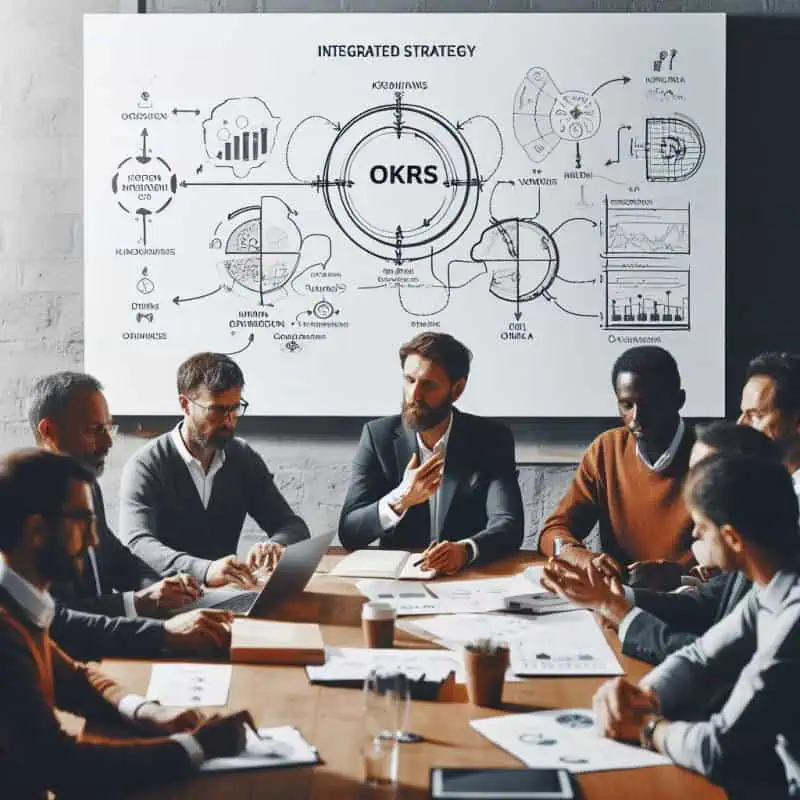
The primary goal of any organization is to achieve success and excellence in the committed market. To achieve this, the organization must define an effective and integrated strategy. The OKRs (Objectives and Key Results) method is one of the useful and effective tools to help define goals and measure success. In this article, we will learn how to build an integrated strategy using OKRs, focusing on practical details and examples.
OKRs Concept
The OKRs method is based on defining Objectives and Key Results as a basis for measuring achievements and progress. Objectives are what the organization wants to achieve, while Key Results are the measurable outcomes that show the organization's progress towards achieving the objectives.
Steps to Build an Integrated Strategy Using OKRs
- Define Vision and Purpose: The organization must clearly define its vision and purpose before starting to build an integrated strategy. The vision includes the organization's expectations for the future and its perception of the ideal situation it wants to achieve. The purpose relates to the main reason behind the organization's existence and what it seeks to accomplish.
- Example: The vision of a technology company might be "to provide innovative technological solutions to improve the quality of life," and its purpose might be "to simplify life through innovation and technology."
- Set Objectives: Based on the vision and purpose, the organization must define the main objectives necessary to achieve them. Objectives should be specific, clear, measurable, and linked to a specific time frame.
- Example: A technology company's objective might be "to increase market share by 15% within the next two years."
- Define Key Results: After defining the objectives, the organization must define the Key Results, which represent the measurable indicators of the organization's progress towards achieving the objectives. Key Results should be tangible, traceable, and updated regularly.
- Example: Key Results for the objective of increasing market share might include "increasing the number of new customers by 10%" and "improving customer satisfaction levels by 20%."
- Communicate Objectives and Key Results: The organization must ensure that Objectives and Key Results are communicated at all levels, from senior management to individual employees. The organization can utilize advanced technological tools to facilitate communication and track progress.
- Review and Update OKRs Regularly: The organization should review and update its Objectives and Key Results periodically (usually every quarter) to ensure continuous progress and improvement. Through review, the organization can identify successes and challenges and take appropriate improvement measures.
Practical Example of Applying OKRs in the Retail Sector:
Objective 1: Improve the customer shopping experience
- Key Results:
- Increase the referral rate from existing customers by 25%.
- Formula: (Number of new referrals / Number of existing customers) * 100 = Referral rate
- Reduce the customer complaint rate by 20%.
- Formula: (Number of complaints / Number of customer interactions) * 100 = Complaint rate
- Increase online store sales by 30%.
- Formula: (Total online store sales / Online store sales in the previous period) * 100 = Percentage increase in online store sales
Objective 2: Improve store operations efficiency
- Key Results:
- Reduce inventory accumulation rate by 10%.
- Formula: (Total current inventory value / Total previous inventory value) * 100 = Inventory accumulation rate
- Reduce labor cost rate by 15%.
- Formula: (Total current labor cost / Total previous labor cost) * 100 = Labor cost rate
- Increase customer flow rate by 20%.
- Formula: (Number of customers entering the current store / Number of customers who entered the store in the previous period) * 100 = Customer flow rate
By applying OKRs correctly, the organization can define the main objectives and their associated key results. The organization can communicate clearly at all levels and achieve tangible progress by focusing on appropriate priorities and continuously measuring performance indicators.
General Understanding of OKRs and Strategy
- Question: What is the primary goal of any organization, according to the text? Answer: The primary goal of any organization is to achieve success and excellence in its committed market.
- Question: What does the quote by Michael Porter at the beginning of the text suggest about strategy? Answer: The quote suggests that a key aspect of strategy is knowing when to say "no," implying that focus and prioritization are crucial for effective strategy.
- Question: What does the acronym OKR stand for? Answer: OKR stands for Objectives and Key Results.
- Question: What is the purpose of using the OKR method? Answer: The purpose of using the OKR method is to help organizations define their goals (objectives) and measure their success in achieving those goals through key results.
- Question: What is the difference between an Objective and a Key Result in the OKR framework? Answer: An Objective is what the organization wants to achieve (the goal), while a Key Result is a measurable outcome that indicates progress towards achieving that objective.
Steps in Building an OKR-Based Strategy
- Question: Why is it important for an organization to define its vision and purpose before setting objectives? Answer: Defining the vision and purpose provides a clear direction and foundation for setting meaningful and aligned objectives. The vision describes the desired future state, and the purpose explains the reason for the organization's existence.
- Question: What are the characteristics of well-defined Objectives? Answer: Well-defined Objectives should be specific, clear, measurable, and linked to a specific time frame.
- Question: What are the characteristics of effective Key Results? Answer: Effective Key Results should be tangible (measurable), traceable (trackable), and updated regularly.
- Question: Why is it crucial to communicate OKRs throughout the organization? Answer: Communicating OKRs ensures that everyone in the organization understands the goals and how their work contributes to achieving them, fostering alignment and focus.
- Question: How often should OKRs be reviewed and updated? Answer: OKRs should typically be reviewed and updated quarterly to ensure continuous progress, adapt to changes, and address challenges.
Application of OKRs in Retail
- Question: In the retail example, what is the formula for calculating the referral rate? Answer: Referral Rate = (Number of new referrals / Number of existing customers) * 100
- Question: What does a lower customer complaint rate indicate in the retail example? Answer: A lower customer complaint rate suggests an improvement in customer satisfaction and service quality.
- Question: How can increasing the customer flow rate benefit a retail store? Answer: Increasing the customer flow rate can lead to higher sales potential and improved store performance.
- Question: How does the use of formulas for Key Results in the retail example help in tracking progress? Answer: The formulas provide a quantitative and objective way to measure progress towards achieving the Key Results, making it easier to assess performance and identify areas for improvement.
- Question: Overall, how does the OKR method, as described in the text, help organizations achieve their goals? Answer: The OKR method helps organizations achieve their goals by providing a framework for setting clear objectives, defining measurable key results, fostering communication and alignment, and enabling regular progress tracking and improvement.
Dr. Ahmed Al-Senosy