
The Future Leadership Triad: Artificial Intelligence, Agile Management, and Organizational Change
Organizational change is no longer a strategic option; it has become an imperative for survival, growth, and prosperity in the digital age. Traditional change management methods, which rely on rigid, linear planning, are no longer sufficient to meet the complex challenges and emerging opportunities of today's market. Organizations that cling to old ways and fail to adapt quickly find themselves outmaneuvered by competitors, losing market share, and struggling to attract top talent.
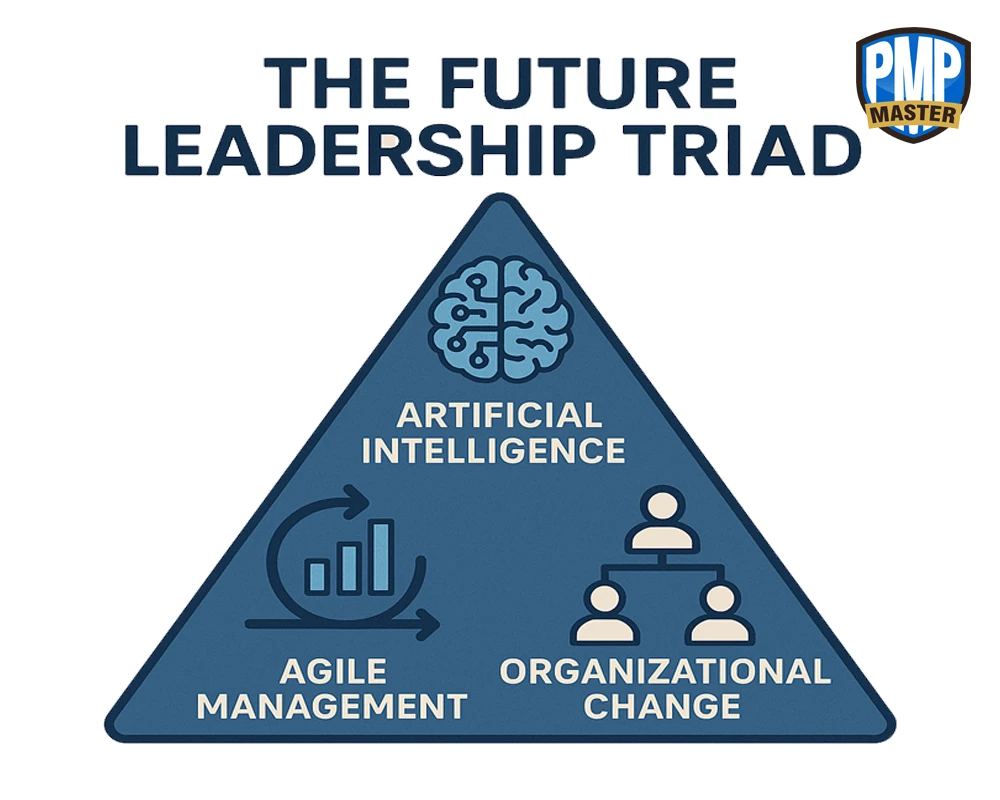
This reality highlights the critical importance of integrating three fundamental pillars that form a powerful triad for future leadership: Organizational Change as an indispensable strategic goal, Agile Management as the flexible methodology to achieve it, and Artificial Intelligence (AI) as the technological engine that enables and accelerates the entire process. The true power lies not in each element in isolation, but in the synergy between them, creating a roadmap for organizations to build a more resilient, innovative, and successful future.
Why Organizational Change is Now a Necessity, Not a Choice
Change today is comprehensive and profound, touching the very core of an organization: its culture, structure, operations, and entire business model. The drivers behind this accelerating need for transformation are numerous:
- Rapid Technological Advancement: Technologies like AI, Machine Learning, and Big Data Analytics require organizations to fundamentally rethink how they operate and deliver value.
- Evolving Customer Expectations: Modern customers expect personalized experiences, rapid responses, and 24/7 availability, along with a growing focus on sustainability and corporate responsibility.
- Fierce and Renewed Competition: New market entrants with disruptive business models force established companies to adapt quickly to maintain their competitive edge.
- Regulatory and Environmental Shifts: New laws (like GDPR for data protection), mounting pressures related to sustainability, and global crises demand constant organizational adaptation.
Organizations that fail to adapt are destined to fall behind. The greatest challenges in this process are often employee resistance to change, a lack of clear communication, and the difficulty in measuring progress and demonstrating a return on investment (ROI).
Agile Management: The Adaptive Methodology at the Heart of Transformation
Originally from the world of software development, Agile has evolved into a new mindset for management that prizes flexibility, collaboration, and rapid response. Its principles have expanded far beyond IT to revolutionize everything from marketing and HR to strategic project management.
Agile is built on core principles that make it ideal for managing change:
- Rapid Response to Change: It relies on short, intensive work cycles (known as "Sprints") that allow for adaptive planning and continuous course correction based on real-time feedback.
- Continuous Collaboration: It fosters intensive teamwork within cross-functional teams and ensures that all stakeholders are consistently involved and aligned.
- Focus on Value: Agile aims to deliver tangible value to the customer frequently and in short intervals, rather than waiting for a final, "perfect" product.
- Constant Learning and Improvement: It incorporates regular reviews (Retrospectives) to assess performance and continuously refine processes, ensuring the organization is always getting better.
Agile is the perfect framework for organizational change because it breaks down massive transformations into small, manageable steps, reducing risk and increasing the chances of successful adoption.
Artificial Intelligence (AI): The Engine of Change and an Accelerator for Agility
AI is no longer a futuristic concept; it is a practical tool that is reshaping business. In the context of change and agility, AI plays a pivotal role as a powerful enabler:
- Data Analysis and Insight-Driven Decisions: AI can analyze vast amounts of data (Big Data) to identify hidden patterns, predict future trends, and evaluate the potential impact of different change scenarios, enabling leaders to make informed, data-driven decisions.
- Automation of Routine Tasks: AI can automate repetitive tasks like data entry or customer service inquiries, freeing up employees to focus on high-value, strategic, and creative work.
- Personalized Learning and Training: AI systems can design custom learning paths for each employee, ensuring they acquire the necessary new skills effectively and reducing resistance that stems from a lack of competence.
- Optimization of Agile Processes: AI can monitor the performance of Agile teams in real-time, identify bottlenecks, suggest optimal resource allocation, and increase the overall productivity and efficiency of change initiatives.
- Proactive Risk Management: AI can analyze data to identify potential risks—such as employee burnout or technical challenges—before they escalate, allowing organizations to develop proactive plans to mitigate them.
Integration for a Better Future: The Success Triad in Action
The true transformative power is unlocked when these three pillars are integrated into a symbiotic relationship:
- AI Provides the Data and Insights for Agile: AI acts as the "brain," discovering opportunities and challenges through data analysis. These insights become the fuel that drives Agile teams to make quick, smart decisions.
- Agile Provides the Framework to Implement AI-Driven Change: Agile acts as the "body," translating AI-driven insights into actionable, adaptable plans. It ensures that changes are implemented iteratively and flexibly.
- AI Measures and Improves the Agile Change Cycle: AI acts as the "feedback loop," monitoring the impact of changes implemented by Agile teams. This data feeds back into the cycle, allowing for continuous refinement and optimization.
This integrated ecosystem creates a positive cycle where the need for change is identified by AI, implemented flexibly through Agile, and its impact is measured and improved by AI, ensuring the organization doesn't just react to change but leads it.
Conclusion
Organizational change is no longer a one-time project; it is an ongoing journey that requires a flexible mindset, intelligent tools, and a commitment to continuous improvement. The organizations that embrace Artificial Intelligence as a strategic partner and adopt Agile Management as a core philosophy will be the ones that not only survive but thrive, innovate, and shape the future. This is the success triad that defines the intelligent, agile organization of tomorrow.
Frequently Asked Questions (FAQs)
Q1: What is organizational change and why is it so urgent today? A1: Organizational change is a fundamental transformation in a company's culture, structure, or business model. It's urgent today due to rapid technological advances, evolving customer behavior, and fierce competition. Companies that don't adapt risk becoming irrelevant.
Q2: What is Agile Management and how does it help with change? A2: Agile is a flexible, iterative project management methodology focused on rapid response and continuous improvement. It supports large-scale change by breaking it down into small, manageable steps, which reduces risk and increases employee adoption.
Q3: How does Artificial Intelligence (AI) contribute to organizational change? A3: AI contributes by: analyzing data for better decision-making, automating routine tasks to free up employees, providing personalized training to upskill the workforce, and proactively managing risks by predicting them before they happen.
Q4: What is the relationship between AI and Agile Management? A4: They have a symbiotic relationship. AI provides the data and insights that Agile teams need to make fast, informed decisions. In turn, Agile provides the flexible framework needed to implement AI-driven changes effectively, creating a cycle of continuous improvement.
Q5: What are the main benefits of integrating Organizational Change, Agile, and AI? A5: This integration enables organizations to increase their adaptability, improve operational efficiency, make more accurate data-driven decisions, reduce the risks associated with change, and achieve a sustainable competitive advantage.
Q6: Is Agile only for the IT sector? A6: No. While it originated in software development, Agile principles like flexibility, collaboration, and value-focus have proven effective across all departments, including marketing, HR, operations, and strategic management.
Q7: How can an organization start this transformation journey? A7: Start with gradual steps: secure commitment from top leadership, invest in building a flexible and data-driven culture, provide training on Agile and AI literacy, and begin with small pilot projects to demonstrate value and learn from experience before scaling up.