
What are Tuckman five stages?
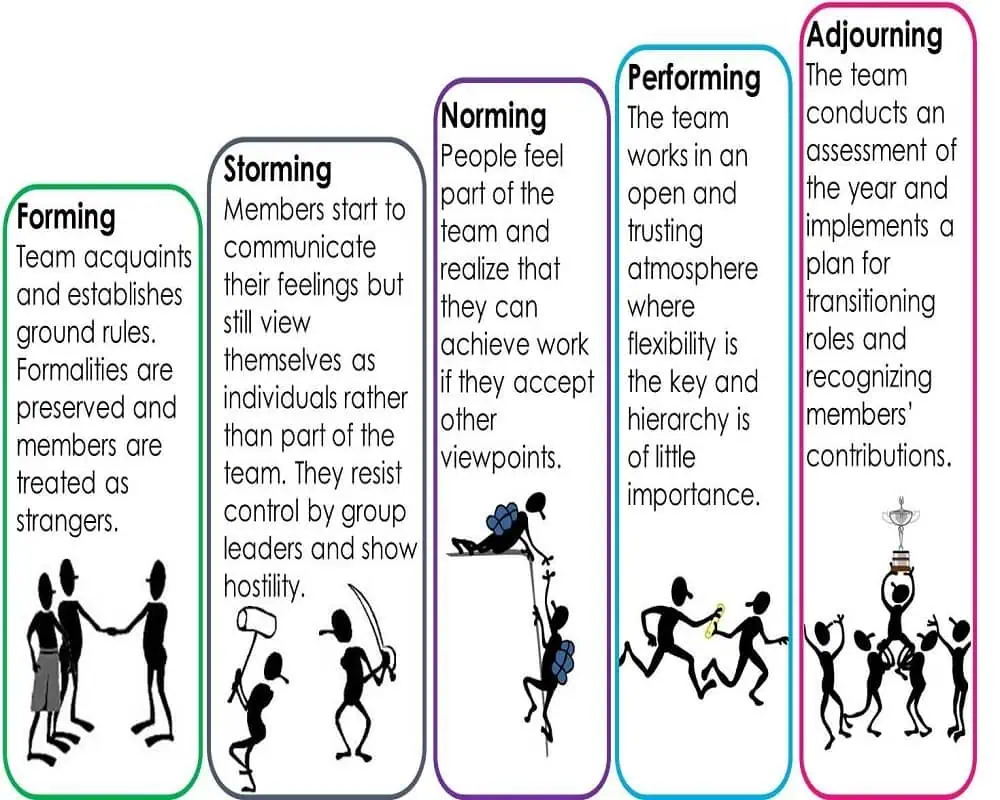
The Five Stages of Team Development: Forming, Storming, Norming, Performing, and Adjourning
Psychologist Bruce Tuckman coined the memorable phrase "Forming, Storming, Norming, and Performing" in his 1965 paper, "Developmental Sequence in Small Groups." It describes the path that teams follow on their way to high performance. Later, he added a fifth stage, "Adjourning," to mark the end of a team's journey.
1. What Happens in the Forming Stage?
Initially, when a new team is formed, individuals may be unsure about the team's purpose, how they fit in, and whether they'll work well with each other. They might be anxious, curious, or excited to get started. Whatever they're feeling, they'll be looking to the team leader for guidance. The team's behavior at this stage is characterized by dependence, with members focusing on how others perceive them.
2. What Happens in the Storming Stage?
In the Storming stage, the team starts to push against the boundaries established around them. Conflict or friction can also arise between team members as their true personalities – and preferred ways of working – emerge and clash with others' styles. At this stage, team members may challenge your authority or management style as a project manager or even the team's mission. If left unaddressed, this can affect the team's performance as a whole. On the other hand, if roles and responsibilities aren't yet clear, individuals may start to feel overwhelmed by their workload or frustrated by a lack of progress.
3. The Norming Stage
Gradually, the team moves into the Norming stage. The team begins to resolve their differences, appreciate each other's strengths, and respect your authority as a leader. Now that they know each other better, your team members will feel more comfortable asking for help and offering constructive feedback. They'll share a stronger commitment to the team's goals, and their performance will become productive.
4. The Performing Stage
Now your team is performing and functioning at full capacity and may reach the highest possible productivity. Through hard work and structured processes, the team is likely to achieve its goals efficiently. Judith Stein of the MIT Human Resources Department says of this stage, "Roles on the team may be more fluid, with members taking on various roles and responsibilities as needed. Differences among members are appreciated and used to enhance the team's performance."
5. The Adjourning Stage
Many teams reach this stage naturally. For example, projects end, or the team is disbanded, and people are reassigned to other projects. Individuals who like routine or have developed close working relationships with colleagues may find this stage difficult.
As a project manager, understanding that these stages occur naturally makes it easier for you to deal with them and move the team to the advanced stages. This also helps avoid many of the negative consequences of the team staying in the Storming stage for too long